
Richland Projected Versus Actual Release
A projected date is a date calculated or displayed before release. An actual release is a completed custody event. Richland County Jail and ODRC use different routes and terms, so a date from one system should not be carried into the other. The jail's official telephone route addresses an active inmate. ODRC's public field is labeled Expected Release Date/Parole Eligibility Date, and the slash signals that it can describe more than one legal point.
A pretrial detainee usually has no sentence-based release date. Bond, a release order, case action, or another hold controls the next step. A sentenced county jail inmate may have a term and confinement credit, but no official Richland County online calculator was found. An Ohio prison record may show an expected or eligibility date, hearing data, sentence terms, and supervision fields.
Find a Richland Projected Date
First decide whether the person is in Richland County Jail or an Ohio prison. Facility location alone can mislead because Mansfield has the county jail and two operating state prisons. A county arrest does not always become an ODRC term. Conversely, a person at Mansfield Correctional Institution or Richland Correctional Institution is searched through the statewide system, not the Sheriff's current roster.
- Confirm the custody system and, when possible, the exact facility and identifying number.
- For an active Richland County Jail inmate, call 419-774-5678 and follow the automated release-information prompts.
- For an Ohio prisoner, open the ODRC Offender Search and search by offender number or exact name.
- Read Status before reading the Expected Release Date/Parole Eligibility Date field.
- Review the sentence type, jail-time credit, hearing month, latest result, POA/PRD date, and supervision start when present.
- Check the sentencing docket for a later judicial release, credit correction, amended sentence, or other order.
- Confirm the final event with the agency. A prior projection does not prove that release occurred.
If the custody system is unclear, the Richland County released inmate search path separates county jail, state prison, court, and federal records. Use the offender number whenever possible. ODRC explains that its county-of-commitment filter means the sentencing county, not a current address, and multiple-county cases may not appear under the county a user expects.
For a local case, choose the court by jurisdiction. Richland County Common Pleas handles local adult felonies. Mansfield Municipal and Shelby Municipal handle matters in their respective areas, and a felony can begin in municipal court before bind-over creates a Common Pleas case number. Locate the sentencing entry, bond order, jail-credit entry, transport order, or later judicial-release decision. The court record explains authority and sentence changes, while the jail record confirms the actual custody processing.
The official ODRC search screen displays the name, number, status, county, ZIP, and parole-hearing inputs used to reach a date record.
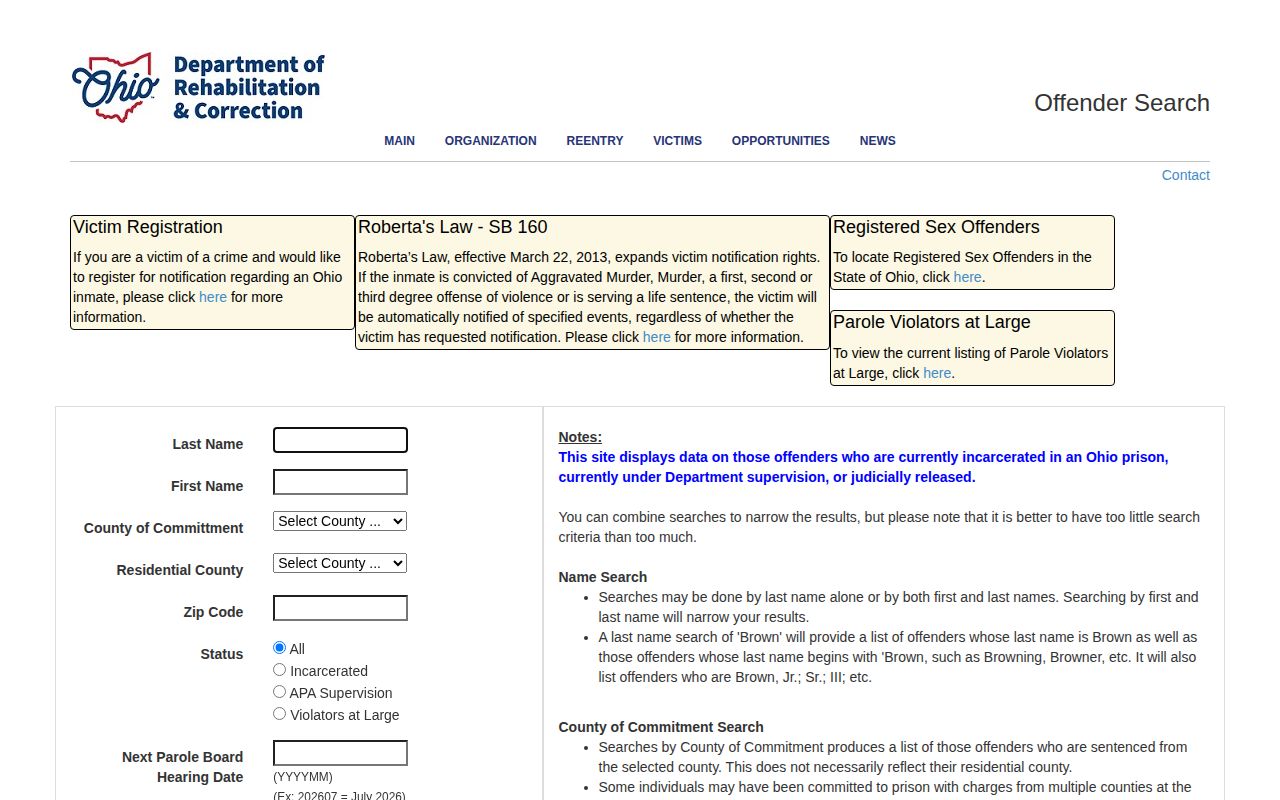
The status filter must be read with the result because Released, APA Supervision, and Incarcerated describe different stages of a Richland County sentence.
Note: ODRC warns of delay and incomplete sentence information, so the sentencing docket remains vital when a date is disputed.
Read Richland ODRC Release Fields
ODRC's expected-date label may mean a projected end point for a definite sentence or a point when parole can be considered. It is not a promise that the gate will open on that day. A separate POA/PRD field means “parole on or after” or projected release date, and it is the earliest authorized release to APA supervision. A hearing result can still continue or deny release.
| ODRC field | How to read it |
|---|---|
| Status | Start here: Incarcerated, Released, APA Supervision, Violator at Large, or another listed status |
| Expected Release Date/Parole Eligibility Date | A projected end point or eligibility point, depending on the sentence |
| POA/PRD | The earliest authorized parole-on-or-after or projected release point to APA supervision |
| Next hearing or review | The scheduled month for board review, not a guarantee of release |
| Latest result | Whether review was continued, denied, granted, or had another outcome |
| Supervision start and period | Evidence that prison custody ended into state supervision when paired with APA status |
| TC/TT Sentence Expiration | A projected release point from a Transitional Control or halfway-house stage |
The ODRC definitions screen provides the agency's exact meanings for these projected and supervision fields.
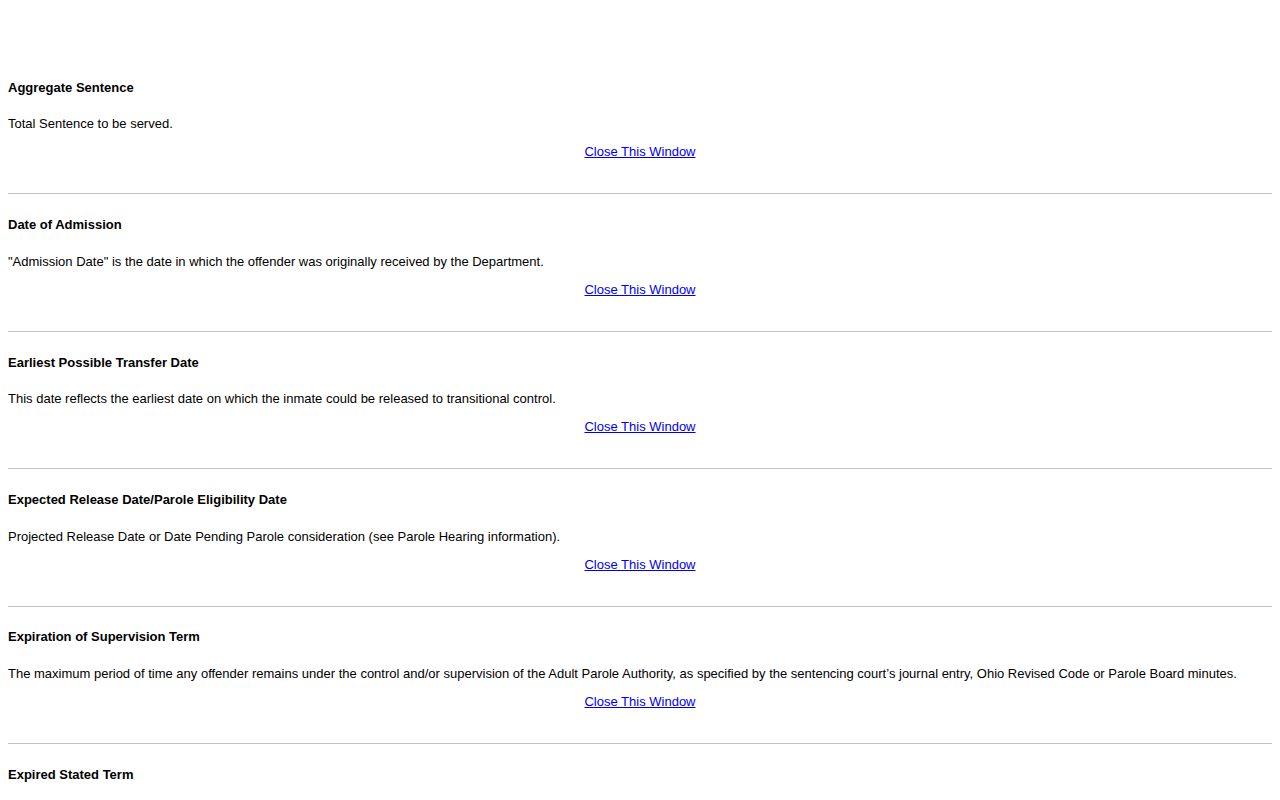
These definitions show why a date must be paired with sentence type, status, and the latest board or court action.
Ohio Credit for Richland Release Dates
Ohio does not have a universal rule that every prisoner serves exactly 85 percent. Ohio Revised Code 2967.194, which applies beginning April 4, 2024, creates eligibility-based earned credit. Eligible people can provisionally earn one or five days for each completed month of specified productive program or activity work. Most qualifying cases fall in the five-day group, while certain older sexually oriented offense cases fall in the one-day group. The statute also authorizes listed completion credit.
The relevant aggregate participation and completion credit has a 15-percent cap under the statute, with a separate formulation for certain completion credit and many detailed limits. That ceiling likely led to the loose “85 percent” shorthand. Yet a maximum possible reduction is not a universal minimum-service rule. Eligibility, the type of term, mandatory portions, program completion, disciplinary action, and statutory exclusions all matter.
Excluded or specially treated categories include death, aggravated murder and murder offenses and related forms, life without parole, terms under ORC 2971.03, specified post-2011 sexually oriented offenses, and mandatory or otherwise non-reducible terms. Credit can be denied or withdrawn for rule violations. Earlier confinement can also implicate ORC 2967.193. ODRC performs the calculation. A homemade date calculation should not replace the displayed record.
No Fixed Richland 85% Rule
The most useful way to apply the Ohio rule to a Richland County record is to avoid a fixed percentage. Read the stated prison term, mandatory components, jail-time credit, current ODRC date, status, and any hearing result. The potential statutory cap does not establish how much credit one person earned, whether a sentence segment qualifies, or whether credit was later denied or withdrawn.
Reagan Tokes indefinite first- and second-degree felony sentences have a minimum and maximum structure of their own, while the earned-credit statute explains how credit applies within its terms. Life and indefinite sentences can also turn on parole eligibility rather than a simple term-end date. Only the current sentence, offense, and governing statute answer those questions.
Why Richland Release Dates Change
A date can move for more than one reason. Some factors affect the computed prison term, while others affect whether release occurs after an eligibility point. County jail timing has its own inputs. Avoid merging these into a single “good time” explanation.
| Factor | Possible effect | Where to check |
|---|---|---|
| Earned credit | May reduce an eligible Ohio prison term within statutory rules | ODRC date and ORC 2967.194 |
| Credit denial or withdrawal | Can remove an expected reduction after rule violations | ODRC record and permitted agency confirmation |
| Jail-time credit correction | Can change the credit applied to the sentence | Sentencing docket and ODRC detail |
| Parole decision | A continued or denied result can prevent release at an eligibility point | ODRC hearing and result fields |
| Judicial release or later order | Can alter the route or timing ordered by the court | Richland County sentencing docket |
| Detainer or other hold | Can end one custody while another authority takes over | Custody agency and relevant authority |
| Transitional Control | Can move a person from prison to residential control before final discharge | ODRC status and TC/TT fields |
A date in the past can remain attached to an old review. ODRC says the next hearing date is reviewed about two months before the displayed month, and the public search accepts a monthly YYYYMM input. Always read the latest result and present status.
Note: A detainer can end Richland County custody without producing an unsupervised community release.
Richland Jail Release Date Line
Richland County has a distinctive direct channel for a person who is still active at the jail. The official jail page states that the auto-attendant can provide when an active inmate is to be released. Call 419-774-5678 and follow the release-information prompts. The county does not publish that projection as a field in its current-custody PDF.
The captured Richland County Jail page documents this active-inmate telephone path.
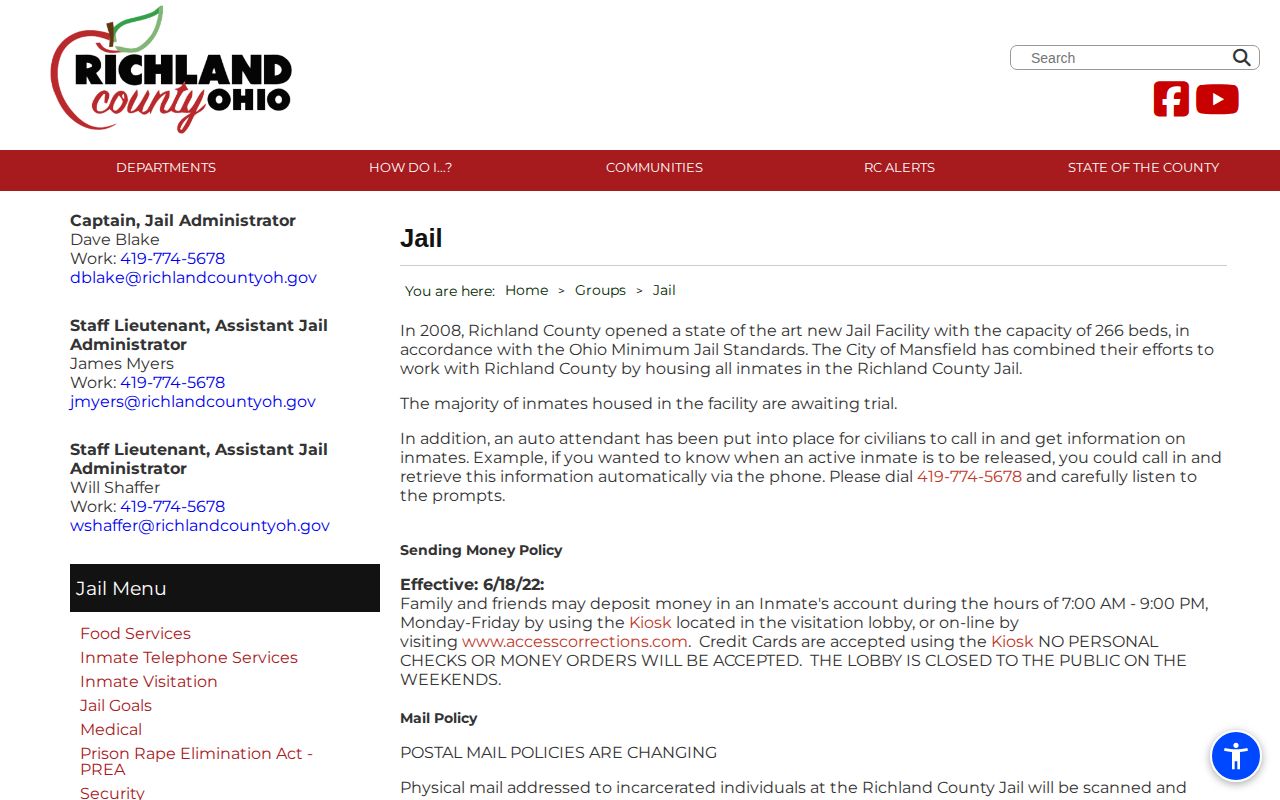
The phone projection is useful before release, but it cannot serve as a retrospective record after the person leaves the current roster.
For completed release, contact Sheriff Records or use the court and VINE event. The final booking-release record can answer the actual date or time. No published Richland County jail good-time formula or weekend-adjustment rule was found, so ODRC earned-credit law must not be imported into a county sentence.
County jail timing can still change because of the sentencing entry, credit for confinement, concurrent or consecutive terms, bond or appellate orders, warrants, other holds, and administrative processing. None of those facts supports a public date calculator. Ask the court for the governing order and the Sheriff's office for the final custody record. If the release involves transfer to ODRC or another authority, the end of Richland County jail custody is not the same as community release.
Richland Parole and Residential Dates
ORC 2967.13 governs many parole-eligibility rules for indefinite and life sentences. Offense and sentence type control the first possible review point. A displayed eligibility date may therefore mean the board can consider release, not that the maximum term ends. Continued, denied, paroled, and other results direct the next step.
ORC 2967.26 authorizes Transitional Control in qualifying cases. A move to the Mansfield Residential Reentry Program can be an exit from a prison institution while correctional control continues. ODRC's TC/TT Sentence Expiration is the projected release from that halfway-house stage. Institution exit, residential placement, APA supervision, and final discharge are four separate points.
For a pending alert, the Richland County VINELink check explains how to register while the person remains in custody. After an event, confirm it through ODRC, the jail, or the court that owns the record.
Final discharge comes after the last controlling term or supervision step ends. A released or supervised status can be accurate while legal control continues. Quote the stage shown in the record, rather than shortening each stage to “out.”